
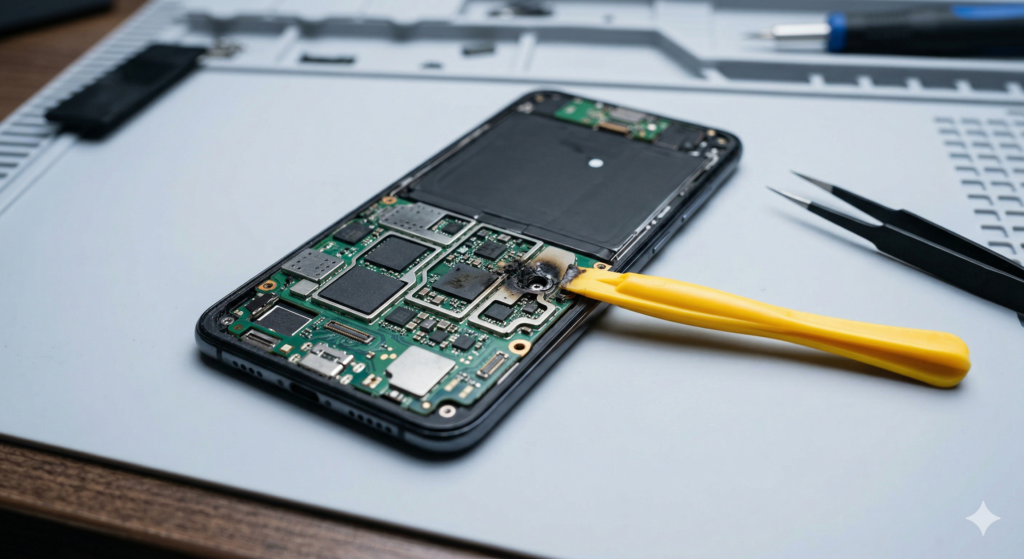
We’ve all seen the ads: a “complete” smartphone repair kit for the price of a takeout lunch, promising that anyone with a steady hand can swap a screen in twenty minutes. It’s an alluring proposition in a DIY-centric culture. However, as 2026 flagship devices become increasingly packed with microscopic architecture, that $20 kit is often a Trojan horse. What begins as an attempt to save a few dollars frequently ends in a “no-power” state—a catastrophic failure where a simple screen swap turns into a $1,000 logic board disaster. Understanding the DIY phone repair risks is essential before you break the factory seal on your primary lifeline.
Section 1: The Precision Gap
The primary issue with home repair kits isn’t just the quality of the plastic tools; it’s the lack of precision environment controls. Modern smartphones are held together by specialized adhesives and “long-screw” versus “short-screw” configurations that are invisible to the naked eye.
A common mistake in the DIY world is “Long Screw Damage.” This occurs when a screw just 0.5mm too long is driven into a hole intended for a shorter one, piercing the multi-layered logic board underneath. This tiny fracture can sever hundreds of microscopic copper traces, effectively killing the device instantly. When you choose to repair a device through professional channels, you are paying for the specialized torque-limited drivers and static-free environments that prevent these invisible fatalities.
Section 2: ESD—The Silent Killer of Electronics
One of the most overlooked DIY phone repair risks is Electrostatic Discharge (ESD). You don’t need to see a spark to destroy a motherboard. The simple friction of your sleeves against a tabletop can generate enough voltage to fry a sensitive power management IC (integrated circuit).
Why Home Environments Fail
- Static Buildup: Carpets and standard plastic tables are breeding grounds for static.
- Lack of Grounding: Professional labs use grounded floor mats and wrist straps to keep voltage at zero.
- Contamination: Microscopic dust particles can bridge connections on the logic board, causing short circuits weeks after the repair is “finished.”
If your DIY attempt has already led to a device that won’t turn on, it may be more cost-effective to sell your device for parts rather than sinking more money into a compromised board.
Section 3: The Fragility of Modern Sensors
In 2026, a phone is less of a “gadget” and more of a biometric vault. Components like FaceID sensors, under-display fingerprint scanners, and ambient light sensors are often “serialized” or paired to the original logic board.
A DIY kit rarely includes the calibration software needed to move these sensors to a new screen. A single slip of a metal pry tool can tear a ribbon cable thinner than a human hair, permanently disabling your phone’s security features. This is why many savvy users prefer to buy a device that has been certified by professionals rather than gambling with the delicate internals of their current one.
Section 4: Conclusion and Final Thoughts
The “Invisible Cost” of DIY isn’t just the price of the kit; it’s the loss of time, data, and the massive hardware replacement fee when a home fix goes south. Your smartphone is a masterpiece of high-precision engineering—it deserves a high-precision solution.
Before you take a screwdriver to your device, consider if the risk to your logic board is worth the small savings. If you’re in the Connecticut area, visiting a local repair location is the fastest way to ensure your phone—and your wallet—remains intact.
Don’t let a $20 kit turn into a $1,000 mistake. Contact us today for a professional diagnostic and repair that keeps your warranty and your data safe.
FAQs
Can a logic board be fixed after a DIY mistake?
Sometimes, but it requires “Level 3” micro-soldering, which is significantly more expensive than the original repair would have been. Prevention is always cheaper than a cure.
Does opening my phone myself void the warranty?
Yes. Most manufacturers include “tamper-evident” seals or software triggers that alert technicians if an unauthorized person has opened the device, typically voiding any remaining warranty.
Is it safe to at least change my own battery?
Batteries are highly volatile. If punctured by a cheap DIY tool, they can vent fire or toxic gas. Because of the heavy adhesives used in 2026 models, professional removal is strongly recommended.
Disclaimer: This article is for informational purposes only. iDoctor is not responsible for any damage caused by attempted home repairs. We strongly advise seeking professional assistance for all electronic hardware issues.